What is the Experiencing STEM FirstHand Project?
While FirstHandTM serves both middle and high school students, this project focuses on FirstHand’s free, 10-week out-of-school STEM program that brings science to life for middle school students in Philadelphia.
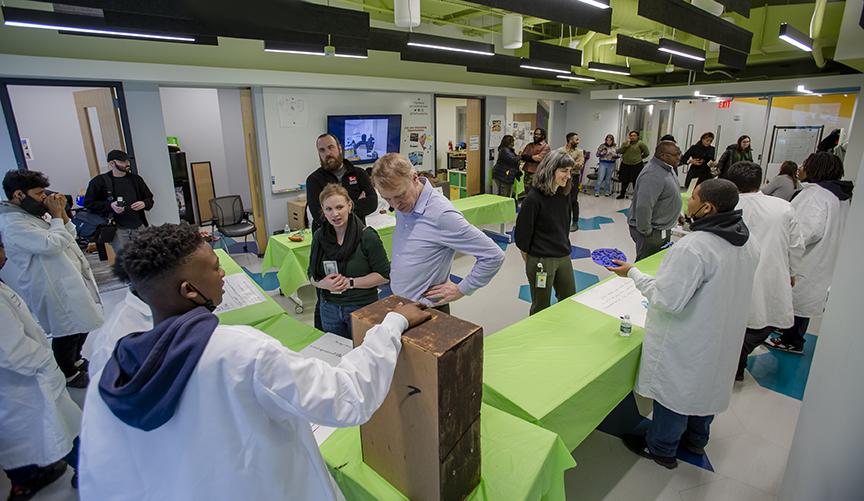
Each week, students leave school and spend two hours in the state-of-the-art FirstHand Lab, where they dive into hands-on, project-based learning grounded in real-world STEM challenges. In partnership with schools, the program tailors curriculum tracks to meet the needs of both students and schools. Program facilitators create a supportive, inquiry-driven environment where students are encouraged to ask questions, plan investigations, and see the relevance of science in their own lives. Working within Philadelphia’s vibrant innovation and entrepreneurship ecosystem, FirstHand connects students with trained STEM professionals who serve as mentors, sharing their career journeys, supporting final projects, and attending student showcase events. By fostering positive relationships, providing authentic exposure to STEM careers, and nurturing students’ sense of belonging and self-efficacy, FirstHand empowers young people not only to envision a future in STEM but also to see themselves as part of it. Supported by a grant from the U.S. Department of Education’s Education, Innovation, and Research (EIR) program, AnLar is partnering with FirstHand to better understand how the program works, the impact it has on students, and how it can continue to grow stronger.
To better understand how the program works, how it can be improved, and the difference it makes, we are conducting three types of evaluation:
- How the Program Works: We are collecting data to see whether the program is running as intended and providing the learning opportunities it was designed to offer.
- How Can It Be Improved? We are exploring ways to make the program better for everyone involved, including students, facilitators, mentors, and teachers.
- What Is the Impact of Participating? We are examining whether participation affects students’ learning, confidence, and attitudes toward science. Specifically, we are exploring whether:
- Students build science skills and knowledge
- Do their grades reflect progress?
- Have teachers observed improvement in STEM skills?
(Data: student grades, teacher ratings)
- Students strengthen their sense of belonging in science
- Do they feel understood, respected, and included?
(Data: student surveys, focus groups)
- Do they feel understood, respected, and included?
- Students learn to value and appreciate science
- Do they find science interesting, useful, and important?
(Data: student surveys, focus groups)
- Do they find science interesting, useful, and important?
- Students enhance their confidence in science
- Are they confident they can understand, learn, and remember science ideas?
(Data: student surveys, focus groups)
- Are they confident they can understand, learn, and remember science ideas?
- Students build science skills and knowledge